Joshua Tree National Park Information Page

Welcome to the Joshua Tree National Park Information Page.
Here you will find all you need to know about the natural history of the park.
Learn about the geology, trees, mammals, birds, or other plants and wildlife of the area.

-SPONSORED LINKS-
Joshua Tree Lodging
Joshua Tree Hotels
Joshua Tree Maps
Joshua Tree Camping
Joshua Tree Weather
Joshua Tree Vacation Rentals
Coyote Corel ©

Sponsored National Park Search

Coyote

Joshua Tree National Park Information
  • Establishment
  • Desert Animals
  • Geology
  • History
  • Index
  • Joshua Trees
  • Life in the Desert
  • Size and Visitation
  • The Desert Fan Palm

  • 
    

    Establishment

    Joshua Tree National Park was proclaimed a National Monument 10 August 1936 by President Franklin D. Roosevelt and redesignated a National Park 31 October 1994. It was sesignated a Biosphere Reserve 1984.

    Mrs. Minerva Hamilton Hoyt, a wealthy California society matron, enjoyed visiting the area that today comprises Joshua Tree National Park. Expanded automobile traffic found its way to the area. Weekend Californians came to the desert to enjoy the clean, clear air, but also to confiscate various species of catcus for their home landscaping. When Mrs. Hoyt saw the devestation left by these weekend visitors, she persuaded President Franklin D. Roosevelt to protect this area by proclaiming it a national monument.


    Size and Visitation

    The origianl Public Law passed by Congress set aside 825,000 acres as Joshua Tree National Monument. In 1950, the monument was reduced to 560,000 acres. The 1994 Desert Protection Act restored 234,000 acres and upgraded the monument to a national park.

    Acreage as of September 23, 2000:
    Federal Land - 954,242.68
    Non-Federal Land - 63,505.35
    Gross Area Acres - 1,017,748.03

    Visitation - 1999
    Total Recreation Visits - 1,316,340

    Joshua Tree National Park is opened year round. The peak visitation month is April. Each season adds its personality to the desert's character. Two deserts come together at Joshua Tree National Park. The Colorado Desert, occupying the eastern half of the park, is dominated by the abundant creosote bush. The higher, slightly cooler and wetter Mojave Desert is the special habitat of the Joshua tree, extensive stands of which occur throughout the western half of the park.


    Geology

    The desert is immense and infinitely variable, yet delicate and fragile. It is a land shaped by sudden torrents of rain and climatic extremes. Rainfall is sparse and unpredictable. Streambeds are usually dry and water holes are few. This land may appear lifeless, but within its parched environment are intricate living systems, each fragment performing a slightly different function and each fragment depending upon the whole system for survival.

    Two deserts, two large ecosystems whose characteristics are determined primarily by elevation, come together at Joshua Tree National Park. Few areas more vividly illustrate the contrast between high and low desert. Below 3,000 feet, the Colorado Desert, occupying the eastern half of the park, is dominated by the abundant creosote bush. Adding interest to this arid land are small strands of spidery ocotillo and jumping cholla cactus. The higher, moister, and slightly cooler Mojave Desert is the special habitat of the undisciplined-looking Joshua tree, extensive strands of which occur throughout the western half of the park. Standing like islands in a desolate sea, the oases provide dramatic contrast to their arid surroundings. Five fan palm oases dot the park, indicating those few areas where water occurs naturally at or near the surface to meet the life requirements of these stately trees. Oases once serving earlier desert visitors now abound in wildlife.

    The park encompasses some of the most interesting geologic displays found in the California's deserts. Exposed granite monoliths and rugged mountains of twisted rock testify to the power of the earth forces that shaped this land. Washes, playas, alluvial fans, interact to form a giant desert mosaic of immense beauty and complexity.

    The geologic landscape of Joshua Tree has long fascinated visitors to this desert. Geologists believe the face of this modern landscape was born more that a million years ago. Molten liquid heated by the continuous movement of earth's crust, oozed upward and cooled while still below the surface. These plutonic intrusions are a grantic rock called monzogranite.

    The monzogranite developed a systems of rectangular joints. One set, oriented roughly horizontally, resulted from the removal, by erosion, of the miles of overlaying rock, called gniess (pronounced "nice"). Another set of joints is oriented vertically, roughly paralleling the contact of the monzogranite with its surrounding rocks. The third set is also vertical but cuts the second set at high angles. The resulting system of joints tend to develope rectangular blocks. Good examples of the joint rock system may be seen at Jumbo Rocks, Wonderland of Rocks and Split Rock.

    As ground water percolated down through the monzogranite's joint fractures, it began to transform some hard mineral grains along the path into soft clay, while it loosened and freed grains resistant to solution. Rectangular stones slowly weathered to spheres of hard rock surrounded by soft clay containing loose mineral grains. Imagine holding an ice cube under the faucet. The cube rounds away under the corners first, because that is the part most exposed to the force of the water. A similar thing happened here but over millions of years, on a grand scale, and during a much wetter climate.

    After the arrival of the arid climate of recent times, flash floods began washing away protective ground surface. As they were exposed, the hugh eroded boulders settled one on the top of another creating impressive piles of rock that can be seen today.

    The "broken terrace walls" laced throughout the bulders are naturally occurring formations called dikes. Younger than the monzogranite, dikes were formed when molten rock was pushed into existing joint fractures. Light colored aplite, pegmarite and andesite dikes formed as a mixture of quartz and potassium minerals cooled in these tight places. Suggesting the work of a stonemason, they broke into blocks when they were exposed to the surface.

    Of the dynamic processes that erode rock material, water, even in arid environments, is the most important. Wind action is also important, but the long range effects of wind are small compared to the action of water.

    The erosional and weathering processes of the present are only particially responsible for the spectacular sculpturing of the rocks. The present landscape is essentially a collection of relict features inherited from earlier times of higher rainfall and lower temperatures.


    The Desert Fan Palm

    In an otherwise hot and sparse environment, palm oases are a luxuriant gift of shade and solace. The verdant display requires a constant supply of water so oases often occur along fault lines, where uplifted layers of hard impermeable rock forces underground water to surface. There are only 158 desert fan palm oases in North America. Five are located in Joshua Tree National Park.

    The desert palm, Washingtonia flifera, is native to the low hot deserts of Southern California where it can live for 80 to 90 years. Towering up to 75 feet, the desert palm is among the tallest of North American palms. It is definitely the heaviset; a mature desert fan palm can weigh as much as three tons. Its distinctive leaves are shaped like a fan and folded like an accordion. They measure up to six feet in length and are nearly as wide. Looking much like "petticoats," the fan palm's dead leaves remain attached to its trunck until removed by fire, wind, or flood.

    Fire is beneficial for palms and rarely kills an adult. In palms, the vascular bundles, those tubes that transport water and nutrients, are scattered throughout the trunk. This arrangement provides insulation from the heat of a fire. In contrast, other trees such as oaks have all their vascular tissues in a ring just beneath the bark. Fire does kill young palms, but it also removes competitors and opens up space for palm seeds to germinate. In fact, desert fan palms increase seed production immediately after fires. A healthy palm can produce as many as 350,000 seeds.

    People have been attracted to palm trees since prehistoric times. Native Americans ate the palm fruit and used the palms to build waterproof dwellings. The Chuillas (pronounced: Ka-wee-yahs) periodically set fire to oases in order to increase fruit production and to remove the sharp edged palm fronds littering the oases floor. The Chuillas also planted palm seeds in promising locations.


    Joshua Trees

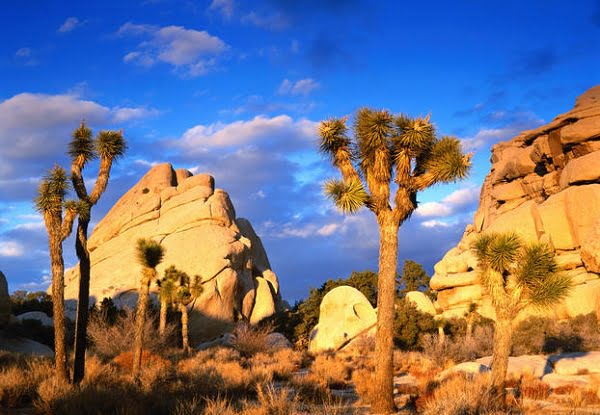
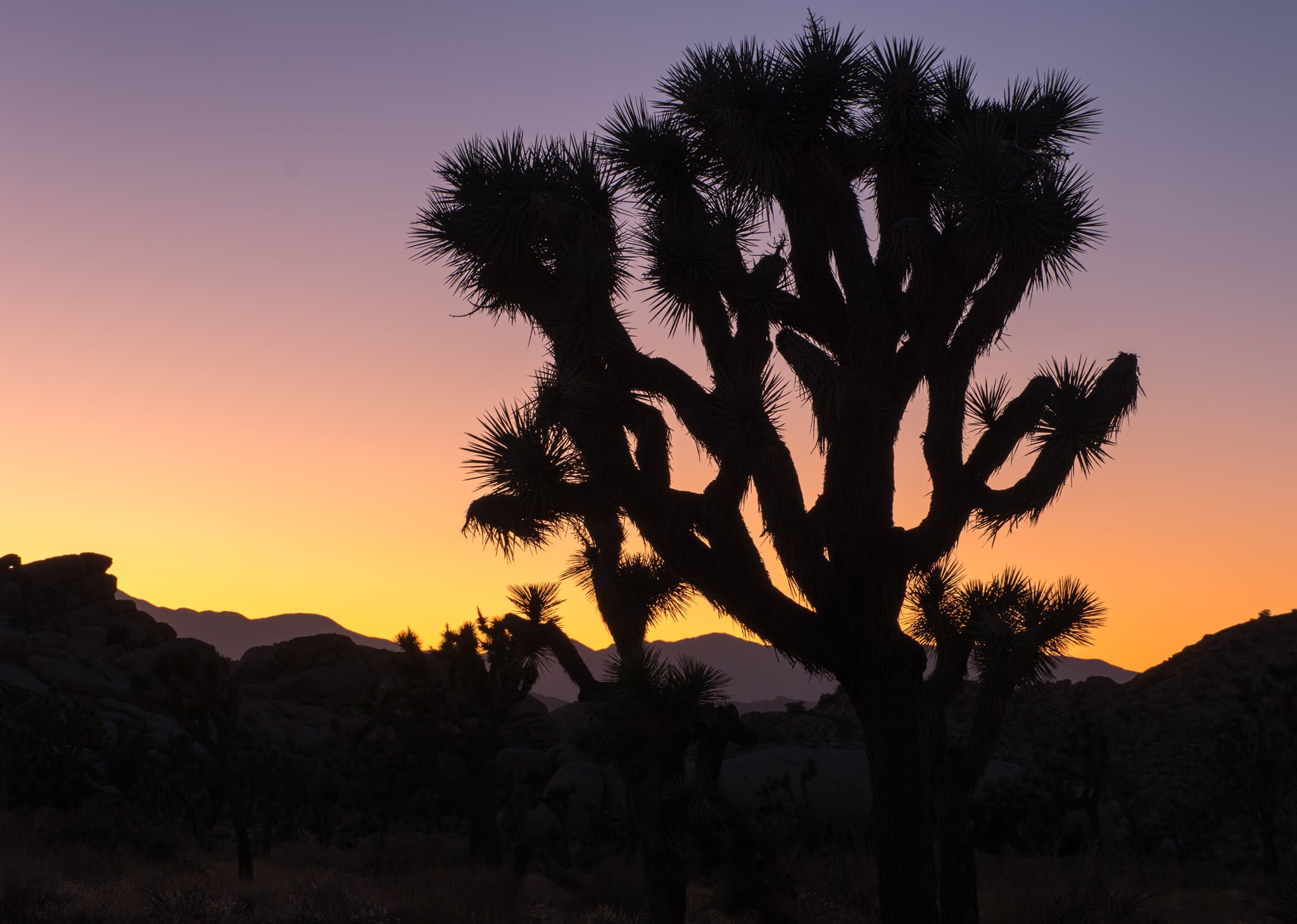
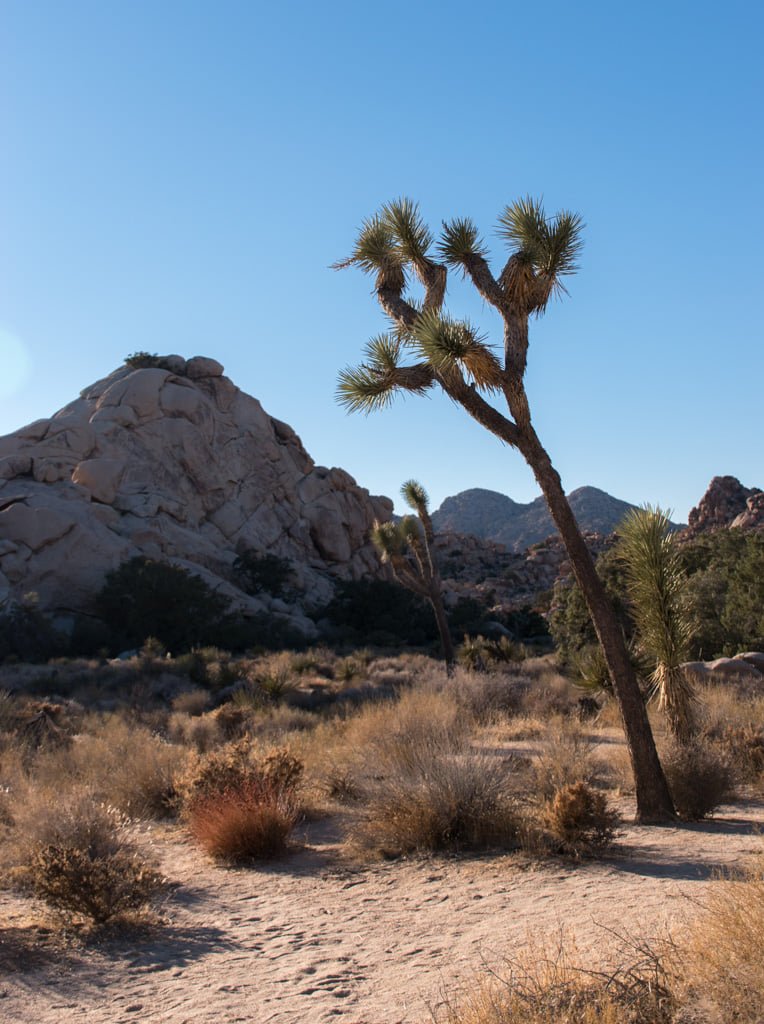
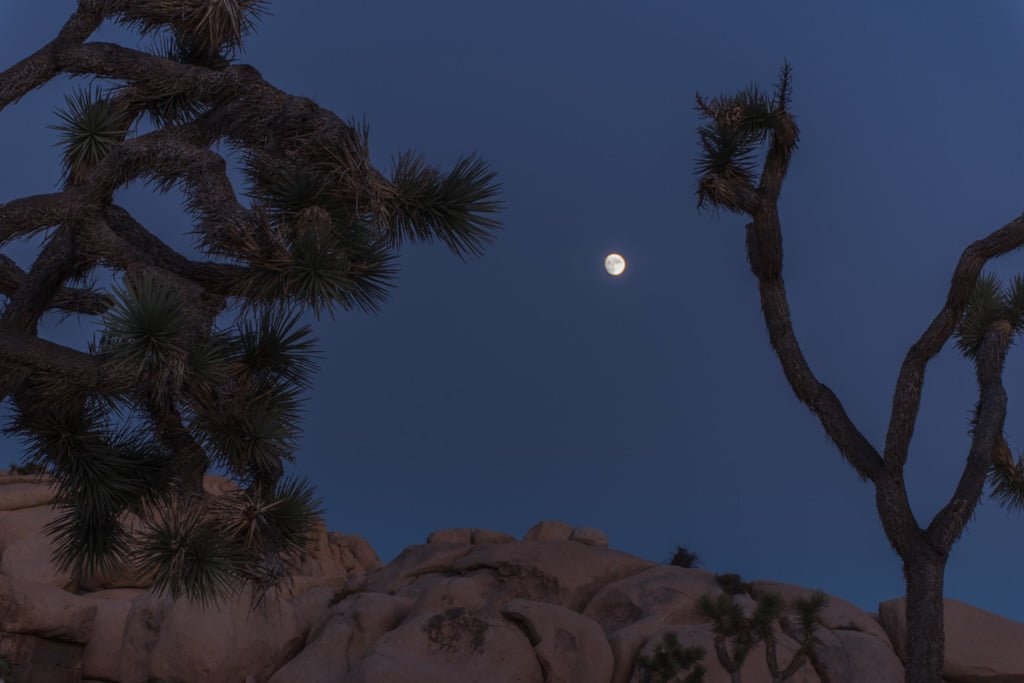
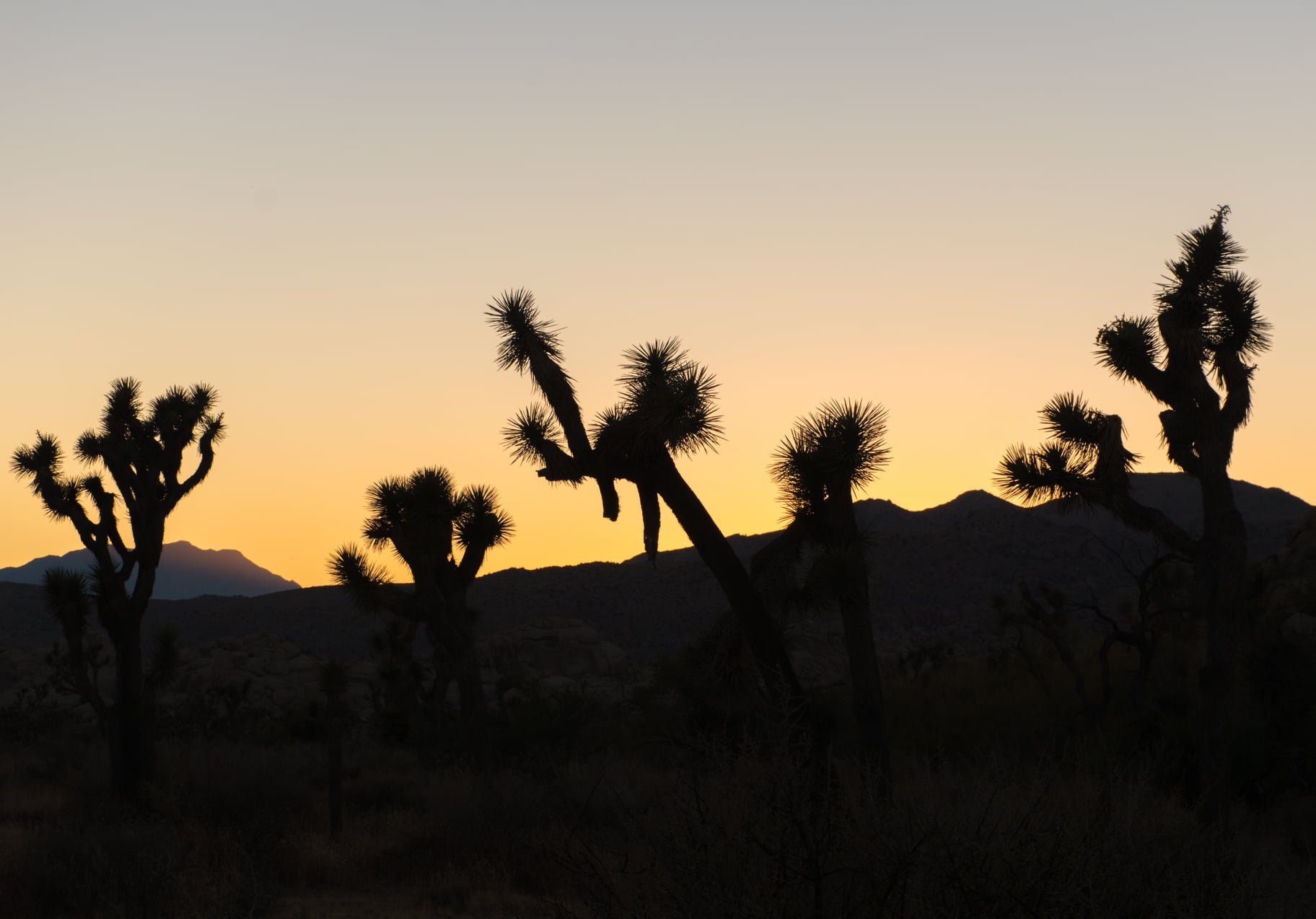
    The Joshua tree, Yucca brevifolia, is a giant member of the lily family. Like the California fan palm, Washingtonia filfera, the Joshua tree is a monocot, in the subgroup of flowering plants which also includes grasses and orchids. The Joshua tree provides a good indicator that you are in the Mojave Desert, but you may also find it growing next to a saguaro cactus in the Sonoran Desert in western Arizona or mixed with pines in the San Bernardino Mountains.

    Years ago, the Joshua tree was recognized by Native Americans for its useful properties; tough leaves were worked into baskets and sandals, and raw or roasted flower buds and seeds made a healthy addition to the diet.The local Cahuilla tribe has long referred to the tree as "hunuvat chiy'a" or "humwichawa;" both names now rest with a few elders still fluent in the language.

    By the mid 19th century, Mormon migrants had made their way across the Colorado River. Legend has it that these pioneers named the tree after the prophet Joshua, seeing the Joshua tree limbs outstretched in supplication, guiding the travelers westward. Concurrent with Mormon settlers, ranchers and miners arrived in the high desert with high hopes of raising cattle and digging for gold. These homesteaders used the Joshua tree's limbs and truncks for fencing and corrals. Miners found a source of fuel for the steam engines used in processing ore.

    Today we enjoy this yucca for its grotesque appearance, a surprising sight in the landscape of biological interest. The Joshua tree's lifr cycle begins with the rare germination of a seed, its survival dependent upon well timed rains. Young sprouts may grow several inches in the first five years, then slow dow, averaging one half inch per year thereafter. The tallest Joshua tree in the park looms a whopping forty feet high, a grand presence in the Queen Valley forest; it is estimated to be over nine hundred years old. These "trees" do not have growth rings like you would find in an oak or pine. This makes aging difficult, but you can divide the height of a Joshua tree by the average annual growth of one half inch to get a rough estimate.

    Spring rains may bring clusters of white green flowers on the long stocks at branch tips. Like all desert blooms, Joshua trees depend on just the perfect conditions: well timed rains and for the Joshua tree, a crisp winter freeze. Researchers believe that below freezing temperatures may damage the growing end of a branch and stimulate flowering followed by branching. Some Joshua trees grow straight stalks; these trees have never bloomed, which is why they are branchless. In additions to ideal weather, the pollination of flowers requires a visit from the yucca moth. The moth collects pollen while laying her eggs inside the flower ovary. As seeds develope and mature, the eggs hatch into larve which feed on the seeds. The tree relies on the moth for pollination and the moth relies on the tree for a few seeds for her young, a happy symbiosis. The Joshua tree is also capable of sprouting from roots and branches. Being able to reproduce vegetatively allows a much quicker recovery after damaging floods or fires which may kill the main tree.

    Many birds, mammals, reptiles and insects depend on the Joshua tree for food and shelter. Keep your eyes open for the yellow and black flash of a Scott's oriole busy making a nest in the yucca branches. At the base of rocks you may find a wood rat nest built with protective spiny yucca leaves. As evening falls, the desert night lizard begins poking around under the log of a fallen Joshua tree in search of tasty insects.

    The Joshua tree is and important part of the Mojave Desert ecosystem, providing habitats for numerous birds, mammals, insects and lizards. Joshua tree forests tell a story of survival, resilience, and beauty borne through perseverance.


    Peoples of Joshua Tree

    As old as the desert may look, it is but a temporary phenomenon in the incomprehensible time- scale of geology. During the pleistocene, one of the Southwest's earliest cultures, the Pinto people, lived here, hunting and gathering along a slow-moving river that ran through the now dry Pinto Basin. Later, other American Indian groups traveled through this area in tune with harvests of pinyon nuts, mesquite beans, acorns, and cactus fruit, leaving behind rock painting and pottery ollas as reminders of their passing. In the late 1800's explorers, cattlemen, and miners came to the desert. They built dams to create water tanks and dug up and tunneled the earth in search of gold. They are gone now, and left behind their remnants; the Lost Horse Ranch and Desert Queen mines and the Desert Queen Ranch. In the 1930's homesteaders came seeking free land and the chance to start new lives. Today many people come to the park's nearly 800,000 acres of open space seeking the clear sky's and clean air, the peace and tranquility, the quietude and beauty that only deserts offer.

    the Desert Queen Ranch

    By 1910, Bill had arrived in the Joshua Tree area and been hired as custodian and assayer of the Desert Queen Mine. Once prosperous, the mine had lost money in recent years. When it finally closed, Bill claimed it and a five-acre mill site for his unpaid wages. In 1917 Keys homesteaded additional acreage adjoining the mill site and this 160 acres became the Desert Queen Ranch. Keys married Frances Mae Lawton the next year.

    The ranger-led tour of the ranch includes the colorful story of the 60 years Bill and Frances spent working together to make a life and raise their five children in this remote location. After years of neglect, the Park Service, with the help of some dedicated and resourceful volunteers, has restored the ranch much as it was in 1969 when Bill died. The ranch house, school house, store, and workshop still stand; the orchard has been replanted; and the grounds are full of the cars, trucks, mining equipment, and spare parts that are a part of the Desert Queen Ranch story.


    Desert Life

    The life force is patient here. Desert vegetation, of times appearing to have succumbed to a harsh and unforgiving environment, lies dormant, anxiously awaiting the rainfall and mild weather that will trigger its growth, painting a profusion of colors. At the edges of daylight and under clear night stars is a fascinating multitude of generally familiar desert wildlife. Waiting out day time heat, these animals run, hop, crawl, and burrow in the slow rhythm of desert life. Under bright sun and blue sky, when the night creatures have long since sought shelter, bighorn sheep and golden eagles add an air of unfettered majesty to this land.

    The desert. Some think it wretched and seemingly useless. For all its harshness, the desert is a land of surprising variety and complexity, a land of extreme fragility. Today's moment of carelessness may leave lasting scars or disrupt an intricate system of life that hints at its hidden vitality. To the close observer, however, a tiny flower bud or a lizards frantic dash reveals Joshua Tree as a place of beauty and life. Take your time as you travel through this area. Joshua Tree National park provides space for finding freedom from everyday routines for self- discovery, and a refuge for the human spirit. Let the desert take hold of you.

    Deserts are composed of plants and animals living together in what seems like an oppressive environment. Living and nonliving elements interact complexly, forming the desert ecosystem. The lifeblood, of course, is the sun's energy, converted to a living form by green plants.

    Unlike most ecosystems, in which plants complete for space in the sun, the desert's sparsity is created in part by too much solar energy. Plants use one of two life strategies to survive. Annuals avoid the extremes, compress their life cycle, and exist while the environment is favorable. Sudden carpets of spring wildflowers are displays of awakened dormancy as seeds, like time travelers, revive to spout flower, and renew their kind. The alternate strategy is that of the patient perennial. Conservative year-round residents like the Joshua tree flourish during the moist periods and bide their time during long droughts.

    Many animals derive their energy from plants, but desert plants give up the fruits of their production only reluctantly. Sharp spines and chemical-laden leaves complicate the lives of plant-eaters. The kangaroo rat avoids these obstacles by eating seeds. While safe to eat, seeds can be hard to find. Many are small, looking surprising like the sand grains that offer them sanctuary. These kangaroo rats uses sensitive front paws to sift through the sand, discovering seeds by smell as well as by touch. Seeds consumed by the kangaroo rat are converted into animal tissue.

    Energy continues to flow through the web as kangaroo rats and other plant-eaters, such as jackrabbits, fall prey to meat-eaters. It takes many rabbits and rodents to feed a single owl, coyote, bobcat, or eagle, so there must be far more prey than predators. The original solar energy converted to plant tissue has now been transformed several times as it moves through the food web.

    As the original source of living energy, plants fulfill a vital role in the food web. A large productive plant such as the Joshua tree resembles a focal point for a complex community of wildlife. Some birds nest in the living tree. Others come regularly to feed on resident insects. Discarded limbs or the toppled body of the tree provide homes for the yucca night lizard and termites. Even in death, the plant energy of the Joshua tree is converted by termites to animal energy. Termites find protection from heat, cold, and drying winds in the decaying fiber. The yucca night lizard finds the same environmental sanctuary along with its preference for food, termites. Energy continues to flow in the web as an owl or snake feeds on an unwary night lizard. As the Joshua tree continues to decompose, stink-bugs may nibble on the fiber, helping termites consume their home. Eventually all the plant's nutrients and energy have been transformed into another living form or released into the soil for use by other plants. The web is fragile, no stronger than its weakest link, yet it endures.


    Wildlife in the Desert
    Animal Description
    Bobcat The short, powerful bobcat body is adapted to pounce from ambush on birds, rodents, and rabbits. Keen senses, patience, and night shadows aid this shy cat.
    Burrowing Owl Vacant rodent burrows in open areas provide ready-made, well insulated homes for this small owl. It feeds on insects, reptiles, and rodents at dusk. It spends the warm daylight hours basking at the burrow entrances. Agitated, it bobs and bows, and crackles to ward off intruders. It has a mellow rolling call; coo-coo.
    Coyote Its skill as a hunter, and its appetite for anything swallowable , ensures this desert carnivore's success. Its diet may include insects, lizards, snakes, birds, rabbits, carrion, fruit, nuts, grass, tennis shoes, or young tortoises. Coyotes are renowned for howling, but they also bark playfully.
    Golden Eagle The rabbits and squirrels that evade the night hunters must still search the day time skies for the silhouette of the stately golden eagle. Its keen eyes scan the landscape for the slightest movement as it soars from the mountain heights out over the valleys and desert floor. Its golden nap is visible only at close range. Its soft voice is hardly ever heard.
    Jackrabbit Muted jackrabbit fur colors provide a motionless defense from the searching eyes of many predators; coyote, bobcats and eagles. Strong eyes and keen hearing send the powerful legs into motion. Young are born well furred.
    Kangaroo Rat To survive in the desert on seeds alone is a challenge few can meet. Seed metabolism produces nutrients and minimal water, enough for this conservative rodent. Large hind feet are adapted for travel over desert sand. Cheek pouches minimize night foraging and exposure to predators.
    Roadrunner This bird is a specialist with a body designed for desert life. Roadrunners get their moisture from their prey; reptiles, insects, rodents, and young birds. Powerful legs rather than wings, serve the bird well.
    Sidewinder This small and mostly nocturnal rattlesnake moves by looping sideways in J-shaped curves, an efficient mode of travel on soft sand dunes and washes it inhabits. It waits in ambush for small rodents it detects by sight or body temperature.
    Stinkbug Stilting across the sand, this large black beetle freezes in a handstand pose at the slightest disturbance. Emission of a pungent odor repels predators. The pose is enough to stop those familiar with this scavenger.
    Tarantula This largest desert spider is not poisonous to humans but bites painfully if provoked. It feeds on insects, but may fall victim to the large, colorful tarantula hawk wasp. A tarantula may inhabit a burrow for years.

    This information was provided by the National Park Service


    Joshua Tree National Park Links
    Bullet Activity & Calendar Page
    Bullet Address, Email & Phone Guide
    Bullet Backcountry Camping
    Bullet Biking & Four Wheeling
    Bullet Birding
    Bullet Brochures, Maps, Written Info
    Bullet California Riding & Hiking Trail
    Bullet Camping Guide
    Bullet Climbing Guide
    Bullet Chat
    Bullet Desert Animals
    Bullet Establishment
    Bullet Fees
    Bullet Geology
    Bullet Hiking Guide
    Bullet History
    Bullet Horse Info
    Bullet Jobs, SCA, Volunteer Positions
    Bullet Joshua Trees
    Bullet Junior Ranger Programs
    Bullet Life in the Desert
    Bullet Location
    Bullet Lodging Guide
    Bullet Map Guide
    Bullet Milage Chart
    Bullet Oasis
    Bullet Park Information
    Bullet Pet Information
    Bullet Search
    Bullet Sights Guide
    Bullet Size & Visitation Info
    Bullet The Desert Fan Palm
    Bullet Travel Guide
    Bullet Visitors Guide
    Bullet Weather
    Bullet Wildflower Blooming Guide

    Joshua Tree National Park
    California National Parks
    Back to National Parks
    Equip yourself for your next National Park adventure by visiting our Outdoor Gear and Equipment Store


    by John William Uhler

    Copyright © 1995 - 2007 Hillclimb Media

    This site is in no way associated with the United States Government, the Department of the Interior or the National Park Service

    Demand Media Network