Joshua Tree National Park Sights Page

Welcome to the Joshua Tree National Park Sights Page
It is our intent to provide information that will be timely and of assistance in planning a trip, vacation or obtaining data about this park

-SPONSORED LINKS-
Joshua Tree Lodging
Joshua Tree Hotels
Joshua Tree Maps
Joshua Tree Camping
Joshua Tree Weather
Joshua Tree Vacation Rentals
Cactus Wren - Corel ©

Sponsored National Park Search

Sights To See
  • Biking Roads
  • Biking & Four Wheeling
  • Birding
  • General Information
  • Geology Road Tour
  • Oasis
  • Planning a Visit
  • Wildflowers

  • 
    

    General Information

    Joshua Tree National Park is immense, nearly 800,000 acres, and infinitely variable. It can seem unwelcoming, even brutal during the heat of summer when, in fact, it is delicate and extremely fragile. This is a land shaped by sudden torrents of rain, strong winds, and climatic extremes. Rainfall is sparse and unpredictable. Streambeds are usually dry and waterholes are few. Viewed in summer, this land may appear defeated and dead, but within this parched environment are intricate living systems waiting for the opportune moment to reproduce. The individuals, both plant and animal, that inhabit the park are not individualists. They depend on their entire ecosystem for survival.

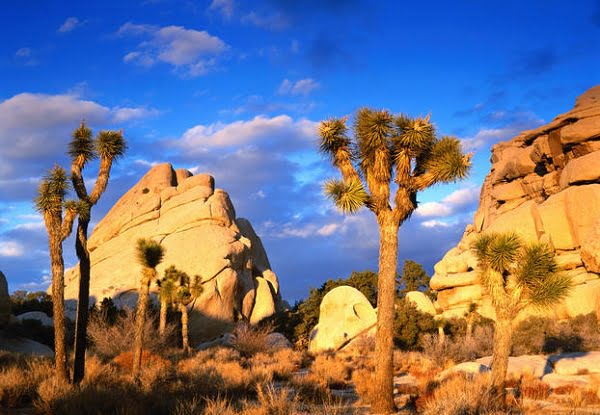
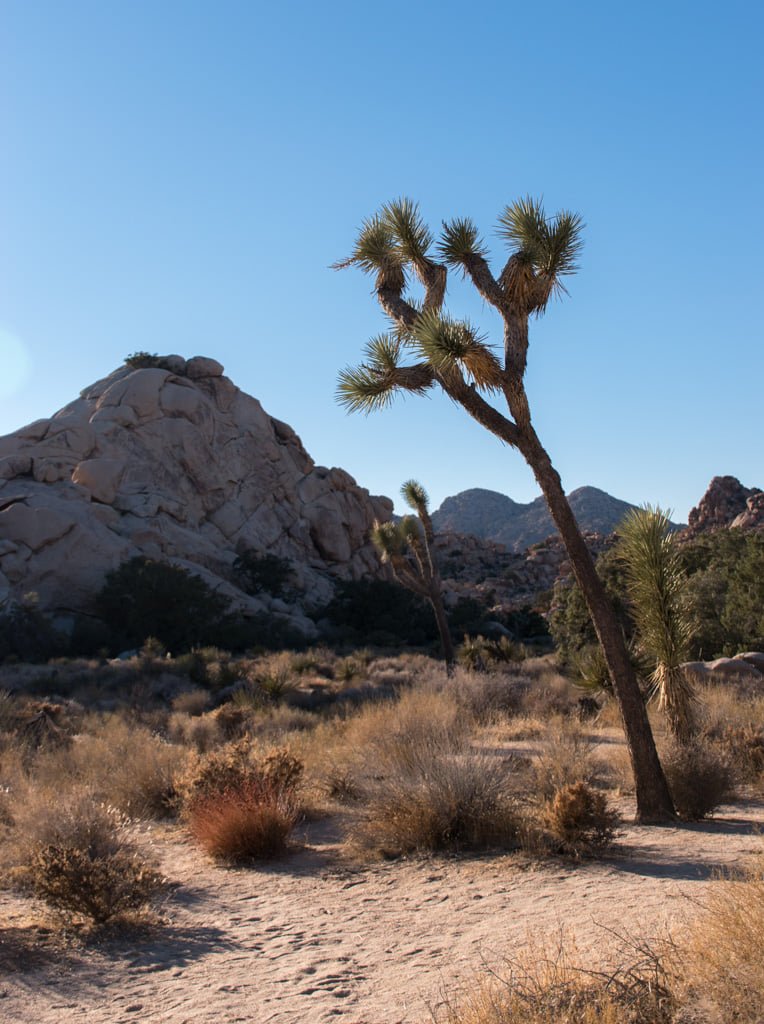
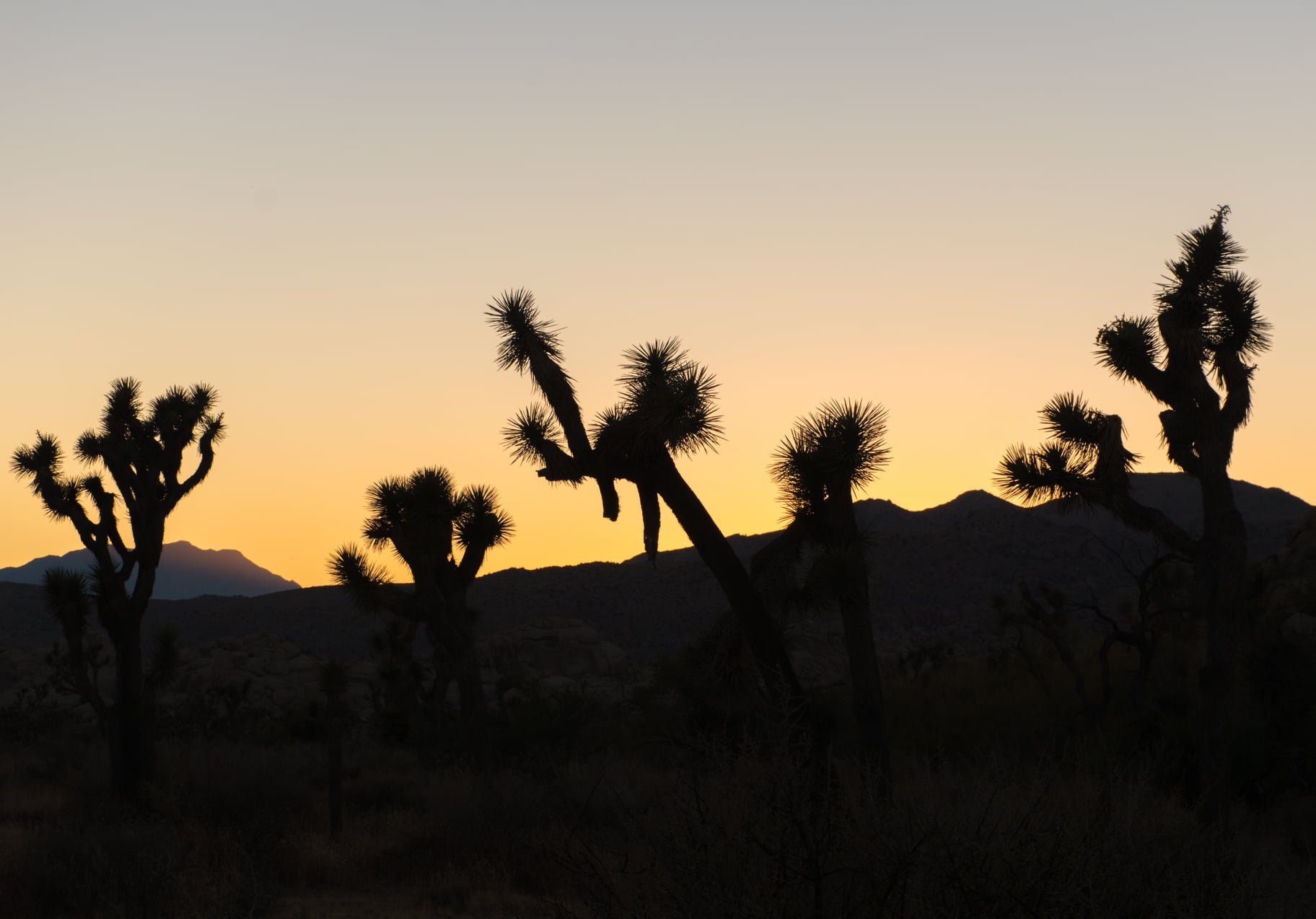
    Two deserts, two large ecosystems primarily determined by elevation, come together in the park. Few areas more vividly illustrate the contrast between �high� and �low� desert. Below 3,000 feet (910m), the Colorado Desert, occupying the eastern half of the park, is dominated by the abundant creosote bush. Adding interest to this arid land are small stands of spidery ocotillo and cholla cactus. The higher, slightly cooler, and wetter Mojave Desert is the special habitat of the undisciplined Joshua tree, extensive stands of which occur throughout the western half of the park.

    Standing like islands in a desolate sea, oases, a third ecosystem, provide dramatic contrast to their arid surroundings. Five fan palm oases dot the park, indicating those few areas where water occurs naturally at or near the surface, meeting the special life requirements of those stately trees. Oases once serving earlier desert visitors now abound in wildlife.

    The park encompasses some of the most interesting geologic displays found in California�s deserts. Rugged mountains of twisted rock and exposed granite monoliths testify to the tremendous earth forces that shaped and formed this land. Arroyos, playas, alluvial fans, bajadas, pediments, desert varnish, granites, aplite, and gneiss interact to form a giant mosaic of immense beauty and complexity.

    As old as the desert may look, it is but a temporary phenomenon in the incomprehensible time-scale of geology. In more verdant times, one of the Southwest�s earliest inhabitants, members of the Pinto Culture, lived here, hunting and gathering along a slow moving river that ran through the now dry Pinto Basin. Later, Indians traveled through this area in tune with harvests of pinyon nuts, mesquite beans, acorns, and cactus fruit, leaving behind rock paintings and pottery ollas as reminders of their passing. In the late 1800s explorers, cattlemen, and miners came to the desert. They built dams to create water tanks and dug up and tunneled the earth in search of gold. They are gone now, and left behind are their remnants, the Lost Horse and Desert Queen mines and the Desert Queen Ranch. In the 1930s homesteaders came seeking free land and the chance to start new lives. Today many people come to the park�s 794,000 acres of open space seeking clear skies and clean air, and the peace and tranquility, the quietude and beauty, only deserts offer.

    The life force is patient here. Desert vegetation, often appearing to have succumbed to this dry sometimes unrelentedly hot environment, lies dormant, awaiting the rainfall and moderate weather that will trigger its growth, painting the park a profusion of colors. At the edges of daylight and under clear night stars lives a number of generally unfamiliar desert animals. Waiting out daytime heat, these creatures run, hop, crawl, and burrow in the slow rhythm of desert life. Under bright sun and blue sky, bighorn sheep and golden eagles add an air of unconcerned majesty to this land.

    For all its harshness, the desert is a land of extreme fragility. Today�s moment of carelessness may leave lasting scars or disrupt an intricate system of life that has existed for eons. When viewed from the roadside, the desert only hints at its hidden life. To the close observer, a tiny flower bud or a lizard�s frantic dash reveals a place of beauty and vitality. Take your time as you travel through Joshua Tree National Park. The desert provides space for self-discovery, and can be a refuge for the human spirit.

    Visitor centers, ranger stations, entrance stations, and wayside exhibits are located along main roads leading into and through the park. These provide you with opportunities to acquaint yourself with park resources. Publications about the park are sold by the Joshua Tree Natural History Association at visitor centers.

    Walks, hikes, and campfire talks are conducted chiefly in the spring and fall; information is posted on campground bulletin boards, at ranger stations, and at visitor centers. Ranger conducted activities can increase your enjoyment and understanding of the park.


    Planning a Visit

    If you have four hours or less

    With limited time, you may want to confine your sightseeing to the main park roads. Many pullouts with wayside exhibits dot the park roads. A list of nature trails and short walks are available in the park newspaper. Consider experiencing a least one of these walks. On clear days the vista from Keys View extends beyond Salton Sea to Mexico and is well worth an additional 20 minute drive.

    If you have an entire day

    There will be time to walk several nature trails. If you visit on a weekend from mid October to mid December or mid February through May, you can participate in a ranger led program. Check at the visitor centers and on campground bulletin boards for program listings.

    If solitude is what you are after, plan an all day hike.

    Some visitors like to experience desert from the seat of a mountain bike. The park offers an extensive network of dirt roads that make for less crowded and safer cycling than paved main roads.

    Joshua Tree has gained international attention as a superb rock climbing area. Many visitors enjoy just watching the rock climbers.


    Biking & Four Wheeling

    Mountain bikes and four-wheeled drive vehicles are welcome in the park. For your own safety and for the protection of the natural features of this park, please stay on established roads. Tire tracks on the open desert can last for years and will spoil the wilderness experience of future hikers.

    Paved roads in the park are narrow, without paved shoulders. Curves, boulder piles and Joshua tree restricts the vision of bikers and motorists. The unpaved roads in the park are safer for bikes and offer many opportunities to explore the area.

    Previously, bike riding in the park was restricted to roads open to vehicles. The park's new Backcountry and Wilderness Management Plan designates approximately 29 miles of trails for non-motorized bike use.

    Part of the California Riding and Hiking Trail is now open to biking. The seven-mile section located between North Entrance and Pinto Basin Road traverses a sandy wash much of the way, but includes a short, rather fun, section of compacted trail. If you start at Pinto Basin Road and travel north, it will be a downhill ride and somewhat easier.

    Not all 29 miles of bike trails are currently available, but park staff are working to get them delineated and signed. The park will post updates as trails become ready for use.

    With the exception of the Thermal Canyon trail, bicycle trails will also be open to equestrian use, and all trails are open for hiking. Please use caution on these multiple-use trails.

    Biking Safety


    Biking Roads
    Road Length mi / km Description
    Black Eagle Mine 9.0 / 14.5 Begin 6.5 miles (10.5 km) north of Cottonwood Visitor Center. This dead-end dirt road runs along the edge of Pinto Basin, crosses several dry washes and winds through canyons in the Eagle Mountains. After the 9.0 miles, then you enter Bureau of Land Management land.
    Covington Flats 3.8 / 6.2 (one way) From Covington Flats picnic area to Eureka Peak. Access to some of the park's Joshua trees, junipers, pinyon pines and lush vegetation on this road. The dirt road is steep near the end, but the top offers views of Palm Springs, the surrounding mountains, and the Morongo Basin. Your trip will be 6.5 miles (10.5 km) longer if you ride or drive over to the backcountry board.
    Geology Tour 18.0 / 29.2 Self guiding driving tour along a dirt road winds through some of the park's most fascinating rockscape. Four-wheeled drive vehicles are recommended.
    Old Dale 23.0 / 37.3 Begin 6.5 miles (10.5 km) north of Cottonwood Visitor Center. The first 11 miles (17.8), cross Pinto Basin, a flat sandy dry lake bed. Leaving the basin, the road climbs a steep hill, then crosses the park boundary. A number of side roads veer off toward old mines and residences. The main road leads to Hwy 62, 15.0 miles (24.3) east of Twentynine Palms.
    Pinkham Canyon 20.0 / 32.4 Challenging - begins at Cottonwood Visitor Center, travels along Smoke Tree Wash, and then cuts down Pinkham Canyon. Sections of the road run through soft sand and rocky flood plains. The road connects to a service road next to I-10.
    Queen Tour 11.4 / 18.6 The road turns south from the paved road 2.0 miles (3.2 km) west of Jumbo Rocks Campground. The distance from the junction to Squaw Tank is 5.4 miles (8.8 km). This section is mostly downhill but bumpy and sandy. Starting at Squaw Tank a circular route explores Pleasant Valley.


    Oasis

    Cottonwood Spring Oasis is seven miles from the southern entrance to the park. The spring, the result of earthquake activity, was used for centuries by the Cahuilla Indians, who left bedrock mortars and clay pots, or ollas, in the area.

    Cottonwood Spring was an important water stop for prospectors, miners and teamsters traveling from Mecca to mines in the north. Water was necessary for gold processing, so a number of gold mills were located here. The remains of an arrastra, a primitive type of gold mill, can be found near the spring, and concrete ruins mark the site of two later gold mills in the area.

    A number of hikes begin at Cottonwood Spring. A short, easy walk down Cottonwood Wash leads to a dry falls. In wet years, the falls can become a scene of rushing water and red-spotted toads. Bighorn sheep often come up the wash for water in the early hours. An old teamster road drops down past the falls to the lower wash. A short hike through this lower wash leads through palo verde and desert willow trees to the remains of Moorten's Mill Site. The 3-mile loop trail to Mastodon Peak offers spectacular views, interesting geology, the Mastodon Mine, and the Winona Mill Site. And, for those looking for a longer hike - eight miles round trip - and the largest stand of fan palms in the Park, Lost Palm Oasis.


    Geology Road Tour

    An 18-mile motor tour leads through one of Joshua Tree National Park's most fascinating landscapes. There are 16 stops along a dirt road and it takes approximately two hours to make the round trip. A descriptive brochure that highlights each stop is available at the beginning of the road. At stop #9, Squaw Tank, which is 5.4 miles from the beginning, a chemical toilet is provided and there is adequate turn-out space for returning to the main park road. Or you can proceede on the one-way portion (numbered stops 10 through 16) to continue exploring Pleasant Valley.

    In good weather sedans and trucks may access the route as far as Squaw Tank, stop #9. After that a 4-wheel-drive vehicle is recommended. The road is not suitable for campers, trailers, and motor homes.

    The face of Earth at any particular time represents only a fleeting moment of a very long and dynamic history. Earth is undergoing significant changes continuously and has been since the beginning of time. The science that deals with these changes is called geology. More precisely, geology is the study of processes operating on and within Earth at the present time and, as revealed by the rock record, throughout most of our planet's 4.5 billion year past.

    The area encompassed by Joshua Tree National Park has been restless for at least 1.5 billion years. What we see today is the product of at least two widely separated episodes of mountain building. The later of these episodes was followed by uplift and very deep erosion and then by further uneven uplift along faults. Two rock bodies originally formed deep below Earth’s surface were exposed by this erosion: the 1.7 billion year old Pinto gneiss and the 85 million year old White Tank monzogranite, which intruded the Pinto gneiss as molten magma.

    It is likely that geologic events occurred in this area throughout the vast time before and after the formation of gneiss and the intrusion of the monzogranite. However, the rock record of these events has been lost through deep erosion. The rocks that make up the geologic scenery in the park today are faulted, jointed, weathered, and eroded stubbs of ancient mountains


    Birding

    Joshua Tree's resident bird species, such as roadrunners, phainopeplas, mockingbirds, verdins, cactus wrens, rock wrens, mourning doves, Le Conte's thrashers, and Gambel's quail can be sighted in the park throughout the year. The park's winter migrants: white-crowned sparrows, dark-eyed juncos, sage sparrows, cedar waxwings, American robins, and hermit thrushes will remain in the park into March. Along about the time the winter migratory species are departing, other species will begin to migrate into the area for spring and summer. This group includes summer nesting species such as Bendire's thrashers, ash-throated flycatchers, western kingbirds, Scott's orioles, northern orioles, and western bluebirds.

    A brightly colored bunch of warblers: Wilson's, black-throated gray, Nashville, Mac Gillivray's, yellow, yellow-rumped (a species also here in winter), and orange-crowned are among the species that just pass through the park. Other transients are black-headed grosbeaks, western tanagers, indigo buntings, and lazuli buntings. In addition to these smaller migrants, the park hosts a migration of birds of prey: sharp-shinned hawk, rough-legged hawk, northern harrier, osprey and Swainson's hawk. There are several resident hawks as well: red-tailed hawk, American kestrel, Cooper's hawk, and prairie falcon.

    Occasionally groups of 200 or more turkey vultures will spend the night in the trees at the Oasis of Mara during their spring migration. They present quite a sight especially with their wings slightly spread, warming in the early morning sun. An occasional shore bird also finds its way into Joshua Tree during spring. Do not be too surprised if you see a black-necked stilt or an eared grebe standing on a park road. Grebes have their feet placed so far to the back of their bodies they cannot make a running takeoff on land, once grounded, they are stranded. Please report any sightings to park personnel so the stranded bird can be transported safely to a water site.

    The park's annual National Audubon Society Christmas Bird Count was held on January 1, 2002 and there were only a couple of surprises. Two Lewis' woodpeckers have been staying at the Desert Queen Ranch for the past two months. Check at visitor centers for the tour schedule if you would like to visit the ranch. Another rarity, a downy woodpecker, was reported in the Lost Horse Valley area, but couldn't be found the following week. However an acorn woodpecker was sighted on the Barker Dam Nature Trail shortly after the count. Vermilion flycatcher, homed lark, and mountain bluebird were seen in the Twentynine Palms area during the count.

    Fan palm oases, and water impoundments are good places to search for birds. Even "lakes" that are dry, such as Barker Dam, offer forage vegetation for birds. The Oasis of Mara, including the 29 Palms Inn at the west end, is a good bird viewing area. Cottonwood Spring has both cottonwood trees and fan palms to provide vegetation and shelter for a number of birds. Lost Palms Oasis, 49 Palms Oasis, and the riparian habitat associated with Smith Water Canyon require more extensive hiking but provide good birding as well. When in the high desert areas of the park take a walk or two in the Queen and Lost Horse valleys and look for ladder-backed woodpecker, red-tailed hawk, oak titmouse, bushtit, black-tailed and blue-gray gnatcatchers, black-throated sparrow, and sage sparrow.

    Cottonwood Springs is also one of the best birding spots in the park. The campground, which has water and restrooms, is located 0.5 miles from the Cottonwood Spring via a signed nature trail.

    Interested visitors can stop at a visitor center and pick up a bird checklist that will indicate the likelihood of a particular species being observed during each season. Also ask about any interesting bird sightings or report any unusual sightings you might make. Enjoy your park and its birds.


    Wild Flowers

    The extent and timing of spring wildflower blooms in Joshua Tree National Park may vary from one year to the next. Fall and winter precipitation and spring temperatures are key environmental factors affecting the spring blooming period. Normally desert annuals germinate between September and December. Many need a good soaking rain to get started.

    In addition to rains at the right time, plants also require warm enough temperatures before flower stalks will be produced. Green leaf rosettes may cover the ground in January; however, flower stalks wait until temperatures rise.

    Wildflowers may begin blooming in the lower elevations of the Pinto Basin and along the park�s south boundary in February and at higher elevations in March and April. Desert regions above 5,000 feet may have plants blooming as late as June.

    Lower Elevations: 1,000 � 3,000 ft
    Plant Blooming Dates
    Annuals Feb, Mar and Apr
    Cacti Mar, Apr and May
    Yuccas Mar and Apr

    Higher Elevations: 3,000 � 5,000 ft
    Plant Blooming Dates
    Annuals Mar, Apr and May
    Cacti Apr, May and Jun
    Joshua Trees Mar and Apr
    Yuccas Mar and Apr


    Joshua Tree National Park Links
    Activity & Calendar Page
    Address, Email & Phone Guide
    Backcountry Camping
    Biking & Four Wheeling
    Birding
    Brochures, Maps, Written Info
    California Riding & Hiking Trail
    Camping Guide
    Climbing Guide
    Chat
    Desert Animals
    Establishment
    Fees
    Geology
    Hiking Guide
    History
    Horse Info
    Jobs, SCA, Volunteer Positions
    Joshua Trees
    Junior Ranger Programs
    Life in the Desert
    Location
    Lodging Guide
    Map Guide
    Milage Chart
    Oasis
    Park Information
    Pet Information
    Search
    Sights Guide
    Size and Visitation Info
    The Desert Fan Palm
    Travel Guide
    Visitors Guide
    Weather
    Wildflower Blooming Guide

    Joshua Tree National Park
    California National Parks
    Back to National Parks
    Equip yourself for your next National Park adventure by visiting our Outdoor Gear and Equipment Store


    by John William Uhler

    Copyright © 1995 - 2007 Hillclimb Media

    This site is in no way associated with the United States Government, the Department of the Interior or the National Park Service

    Demand Media Network

    Privacy Policy